
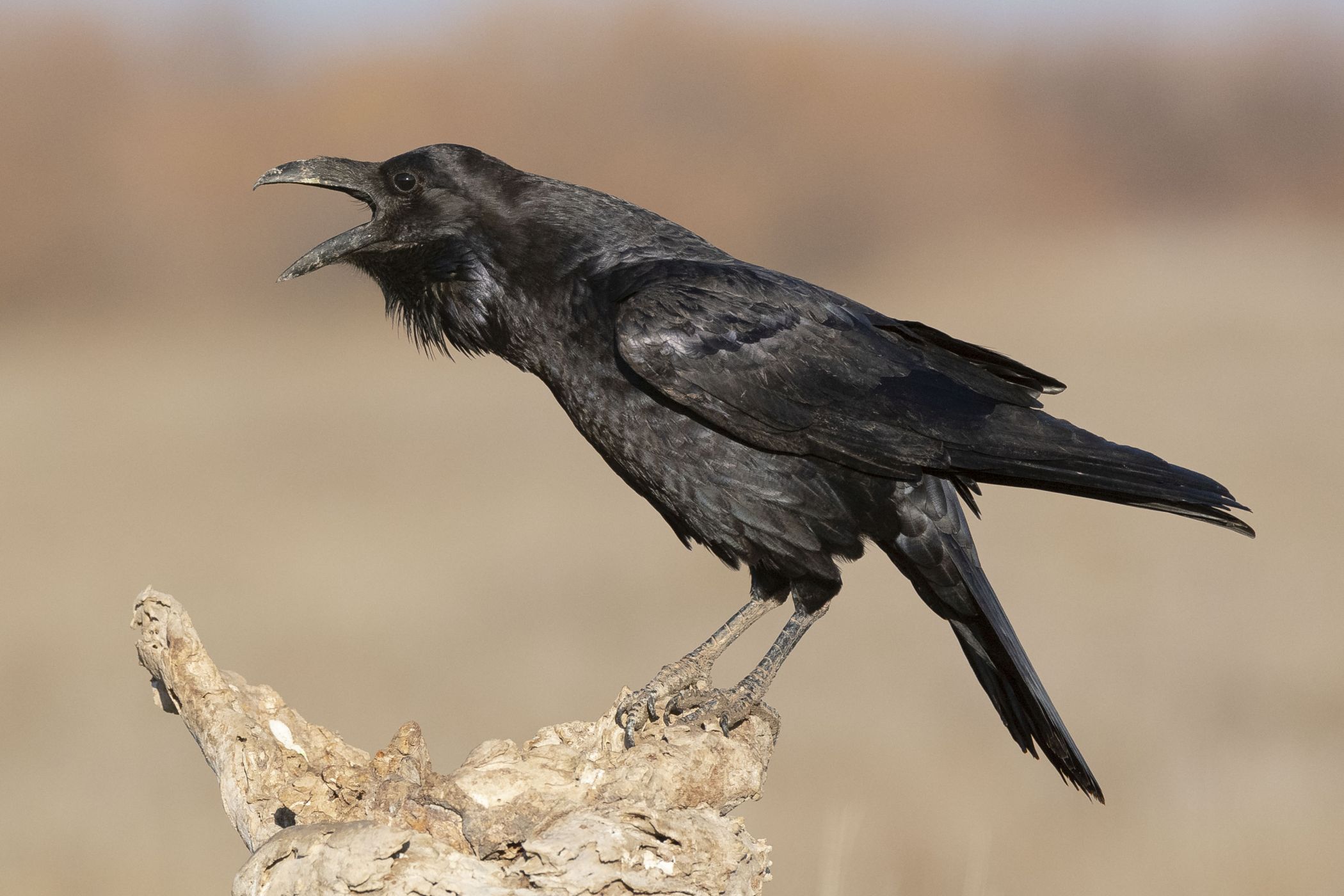
Deep croaks from the crag
The Raven is the heaviest of all songbirds, around 63 cm long, and its usual note is a deep, resonant croak much fuller than any crow’s. Researchers have logged 15 to 30 kinds of call, most of them used between ravens, and a practised ear picks out a rolling ‘prruk-prruk-prruk’. Wild ravens have reached 23 years and more.
On the western cliffs and mountains of Ireland and Britain, the Chough is the crow with red legs and a long, curved red bill. Its call is loud and ringing. A pair bonds for life and keeps coming back to one cave or crevice, and changes in farming are the main cause of its decline in Europe.
Birds of moorland and mountains
Ordered by searches. Several of these birds are summer visitors or live mainly in Scotland, so check the calendar on each page before you set off.
White rumps and white crescents on the moor
A small bird flying off low over the stones, showing a white rump and a black upside-down T on the tail, is a Wheatear. The name is unrelated to any cereal; it is a polite rewrite of white-arse. Wheatears nest in rabbit burrows or cracks between rocks, call a hard ‘chack’ and spend the winter in Africa.
The male Ring Ouzel is mostly black with a clean white crescent across the breast. It breeds on open mountainsides with scattered trees, heather and bilberry, then leaves for southern Europe and North Africa. Lower in the heather you are more likely to flush a Red Grouse, common on heather moorland across northern and western Great Britain and found locally in Ireland.
Snow buntings on the Cairngorm plateau
South of the Arctic, only a few high summits hold small, isolated groups of Snow Buntings. The Cairngorms in central Scotland are one of them, alongside mountains in Alaska and Canada.
In winter both sexes have back feathers edged broadly in orange-brown, a warm brown tone that the summer birds lack.